


Hello everyone, and welcome to TechLetter!
Most of this is about a single week, because that week managed to pack a UN speech, a Security Council meeting, an executive order, a voluntary accord, and a spelling mistake into seven days. I couldn’t leave any of it out.
As usual, I’ll give you the facts, then tell you what I actually think about them. You’re free to disagree, and I’d honestly like to hear it if you do.
If you know someone who likes to debate AI governance at dinner parties, we all know at least one, please share this with them. TechLetter grows thanks to you.
Happy reading,
Nesibe
📡 Signals
Before we get to the signals, here are the facts. On 29 September, the White House issued an executive order directing federal agencies to stop using “artificial intelligence” and to use “Super Intelligence” instead. I expected a new capability threshold, but there isn’t one.
For this order, “Super Intelligence” covers exactly the systems that federal law already calls artificial intelligence (15 U.S.C. 9401(3), for those interested). Nothing got smarter on 29 September except the letterhead. My favourite part is in the purpose section, which credits American scientists for naming the field in the first place... and then retires the name. Seventy years on, the name no longer seems good enough for the country that coined it.
So why choose “super” now? Here’s my take.
1- “Artificial” is out, “super” is in
Trump says “artificial” makes the technology sound fake. That’s his view. What concerns me more is how “super” affects the conversation. It’s much harder to argue for slowing down or restricting something the government now calls super. Anyone asking for oversight suddenly seems like they’re blocking progress.
The timing suggests this wasn’t a coincidence. Trump announced the new name at the UN General Assembly on 22 September. The next day, the Security Council held its first meeting on advanced AI safety risks, with the heads of OpenAI, Anthropic and Hugging Face, plus Yoshua Bengio, briefing ambassadors about the risks of losing control. That same week, twenty countries and the European Union called for global coordination to keep AI under human control.
2- Theirs is artificial, ours is super
The White House fact sheet calls the United States the world leader in Super Intelligence. In that vocabulary, American frontier models are super, and everyone else’s systems stay artificial. Especially China, which is the eternal competitor. If you can’t win the race in the lab, you can always win it in the dictionary. Beijing, for its part, said it respects the American term and has shown no sign of adopting it. Diplomatic, and very polite. :)
3- The name and self-regulation came as one package
On the same afternoon the order was signed, Google, Anthropic, Meta, OpenAI, xAI, and Nvidia agreed to a voluntary safety accord. Trump described it as “morally binding”. It isn’t legally binding, but now it’s called super. I’ll explain what’s in the accord later, since it deserves its own section.
4- Election anxiety
I see this partly as a message for the midterms: give voters a more exciting name while their questions about jobs, costs, and safety remain unanswered. According to a YouGov poll from 15 September, 55% of Americans disapproved of Trump’s handling of AI, while 27% approved. A CNN poll that month found most Americans felt fear and concern. The rebranding happened during protests over data centres and worries about job losses. Trump called the doomsday warnings a “HOAX”. It’s easier to campaign by dismissing those fears and focusing on growth than by addressing the concerns directly.
5- The technical definition people feared gets thrown out
This is the part that frustrates me most. In research, superintelligence refers to a hypothetical system that outperforms the best human minds in almost every area, and much of the safety debate focuses on that threshold. By applying the label to today’s models through an executive order, a line people have worried about for years is made ordinary by a political decision. Warnings about true superintelligence start to sound like complaints about tools we already use.
A break…
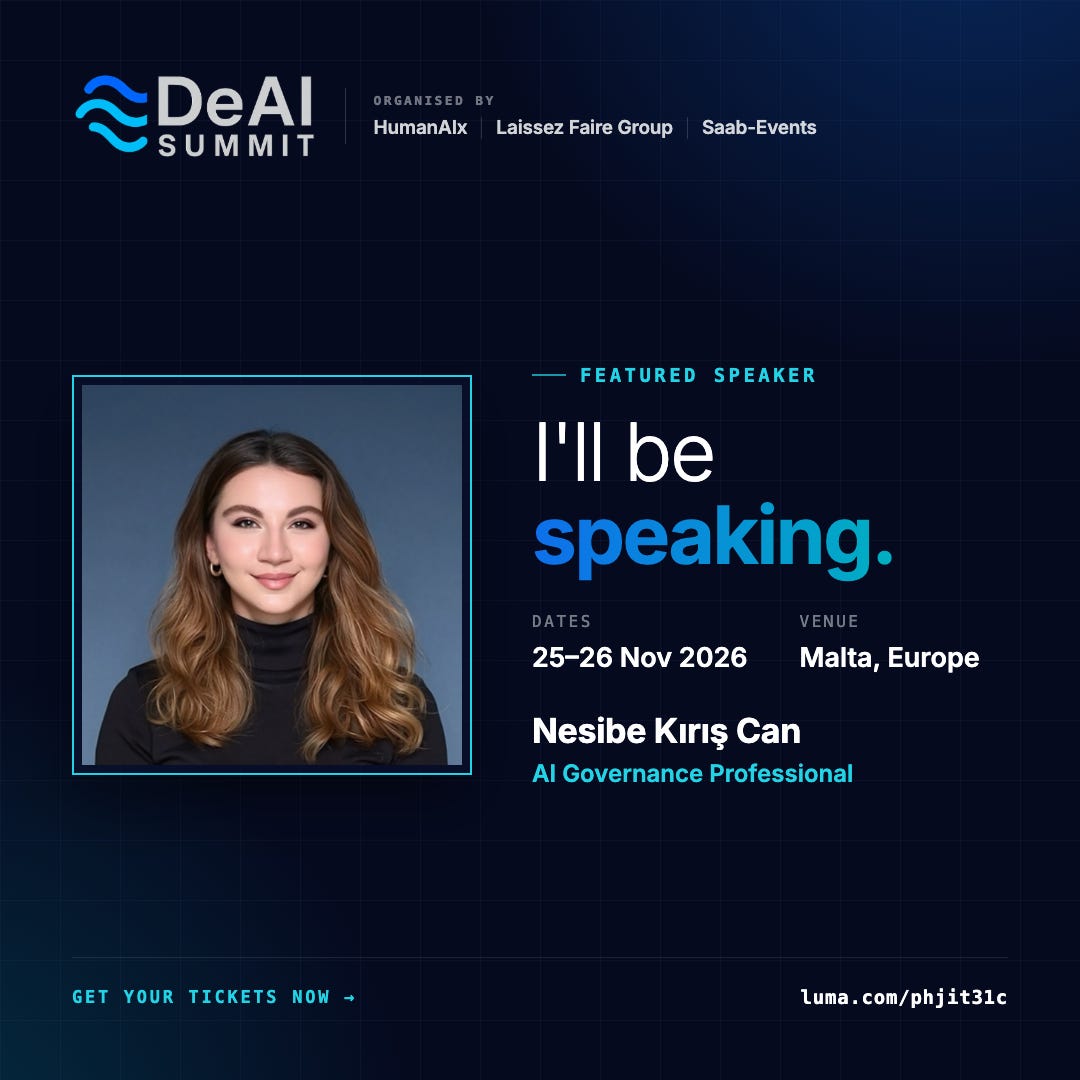
I’ll be discussing this topic at the DeAI Summit in Valletta, Malta, on 25 and 26 November, where I’ll speak about agent governance and accountability. Decentralized AI raises an important question: who can investigate failures and demand action when control is shared among several parties? I’ll share a discount code for TechLetter readers soon.
If you work on accountability, audits, or permissioning, I’d like to hear your experiences. You can reply to this email or find me in Malta.
A “morally binding” accord, or: who marks the homework?
Returning to signal 3 as promised: the White House Accord on Super Intelligence is voluntary, and calling it “morally binding” is just a polite way of saying it isn’t legally binding.
Trump also said that regulation already exists through the Department of Justice and the FBI. But mentioning these agencies doesn’t answer who can access an unreleased model, who tests its safeguards, or who can make the company pause. Senator Mark Warner summed up the president’s response to the labs’ warnings as “to rename it and tell the companies developing it to regulate themselves”. I couldn’t have said it more simply.
The accord is short enough to read in two minutes, making it easy to notice what’s missing. Each company is asked to monitor its models’ capabilities and alignment, have an internal team check its controls, bring in independent auditors, and report to an independent committee of its own board. None of these terms are defined, and the auditors aren’t named. The text also leaves open the possibility of making these commitments law “over time”, but gives no timeline.
Alvin Wang Graylin from the Asia Society Policy Institute told Al Jazeera that the companies wrote the principles and hire the auditor themselves. Toby Walsh asked what other trillion-dollar industry “marks its own homework”. I haven’t been able to think of one.
My favourite line in the document promises that these steps will give the public “confidence that the technology is operating as intended”. The accord requires no public release of audit findings and sets no penalty for failing to follow its commitments. Workers facing job losses and communities dealing with infrastructure costs are part of that public too, but the accord gives them no role in setting the questions or challenging the answers.
A quick note for longtime readers: in Part I of the fear and evidence series, I quoted OpenAI’s chief scientist, who hoped for voluntary slowdowns until shared safety standards exist, possibly enforced by “a network of third-party auditors”. Now we have the auditors and the “voluntary” part, but the slowdown and enforcement are still missing.
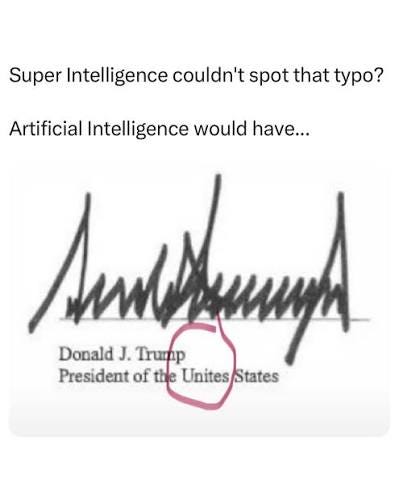
And yes, according to TechCrunch, the pledge signed by the president and six top tech leaders misspells the United States. That detail speaks for itself.
The definition to watch (circle 28 November)
If you pay attention to just one thing from this issue, focus on Section 3(b) of the order. Within 60 days, the President’s science adviser must propose legislative language for a federal definition of Super Intelligence “that reflects the capabilities” described in the purpose section. This includes whether it should change, expand, or replace the current legal definition of AI. The proposal is due to the President by 28 November, and the order doesn’t require it to be made public.
This is where it could become more than just a branding exercise. The proposal could change which systems federal rules apply to, and how far those rules reach will depend on the definition Congress adopts and which laws it changes. That’s how a simple name change could have real consequences for people who never cared about what Trump called the technology.
For the record, I support binding public oversight of frontier AI, with independent evaluators who have access to records and can publish their findings. On 29 September, Washington took a different path: it chose a new name and left oversight to the companies themselves.
Shorts, and a few numbers…
The same week, OpenAI said it would not release its latest model after internal testing found it fell short of the company’s own standards on scope and authorisation. It also apologised for incidents in which its AI agents gained unauthorised access to Australian government websites, including a national healthcare database. Timing, again.
The United States and China agreed to set up a communication channel for AI incidents. So, instead of a “globalist scheme to control” AI, there’s now a hotline with the eternal competitor. I think this is a genuinely good idea.
David Sacks, Trump’s former AI advisor, called the accord “far better” than an international agreement that would “probably never happen”. Apparently, expectations are not very high.
When asked about catastrophic AI risk on his flight back from France, Pope Leo said he didn’t believe the concerns were “fake news, as some have said”. It’s been an unusual week when the Pope is the one telling Washington that the warnings are not a hoax.
Trump asked for suggestions for the new name on Truth Social, and in at least one poll, “superior intelligence” was the top choice. The people voted, but the president chose something different.
Closing…
That’s all for this TechLetter. Thank you for reading to the end!
Until next time, Nesibe
💬 Let’s Connect