


A short edition for a piece of news that earns one. Some announcements need a full breakdown; others just need a clear read before the hot takes harden into consensus. SpaceX buying Cursor is the second kind.

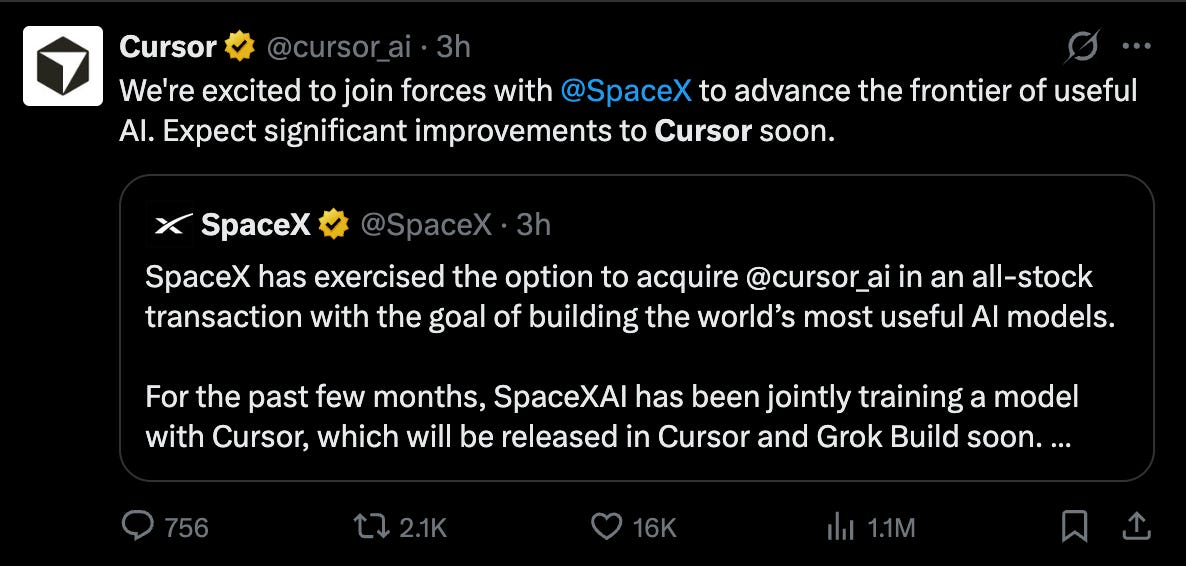
SpaceX signed a $60 billion all-stock deal to acquire Cursor, expected to close in Q3 2026 pending regulatory approval. Musk couldn’t accept falling behind in the AI race, and today he put freshly minted post-IPO stock on the table instead of cash. Within hours the internet had split into three competing readings of what just happened. Here is each one, what it gets right, and what they add up to when you put them together.
My read
The way I see it, this is one move, not a shopping spree: SpaceX is turning raw compute into something developers actually touch, then using that to win the layer that matters most.
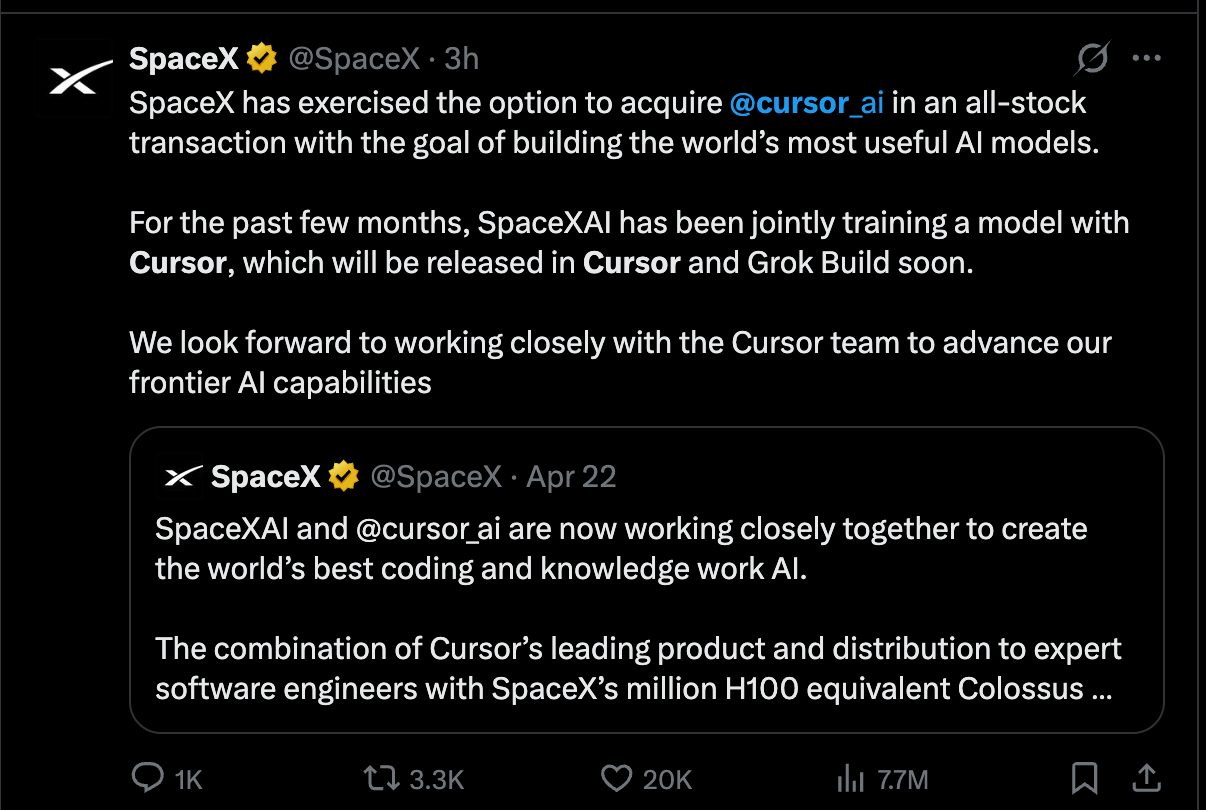
Back in April there was an option agreement on the table. SpaceX opened up its Colossus compute to Cursor and the two started working together. In return, it held a one-sided right: by year end, if it chose to, it could buy Cursor for $60 billion; if it didn’t, it would pay $10 billion for the partnership and the acquisition would fall away. Today SpaceX exercised that right.
Why now? Because the picture changed:
The IPO went through, so SpaceX now holds extremely valuable stock as currency
Cursor has 1M+ daily users, tens of thousands of enterprise teams, and a large share of the Fortune 500
Its annual revenue sits in the $2-3 billion range and is growing fast
Every day, inside the editor, it generates tons of high-signal code plus developer behavior data
You have to read the move across three dimensions:
Compute to product. A supercomputer on its own impresses no one. You have to turn it into a real product that touches developers. Cursor is exactly that: a VS Code based IDE, Composer, long context, terminal. People already live inside it.
Model to data. To build the best coding model, you need to see the best code. Cursor does this perfectly: which suggestion got accepted, which got deleted, refactor, debug, test. All of it real developer behavior, a data mine far richer than classic web scrape.
Distribution to power. For developers the question is no longer which LLM but which workflow. Cursor puts its model straight inside the editor, with code, terminal, tests and repo in one place. Whoever wins the battle to become the default model wins the game, and SpaceX just took that default.
The stack now sits in one hand:
Hardware: Colossus
Model: Grok and xAI
Application: Cursor and Composer
Distribution: X and IDE integrations
From hardware all the way to millions of developers, the chain belongs to a single figure. SpaceXAI and Cursor have reportedly been jointly training a model for months, set to ship in both Cursor and Grok Build soon.
So the Copilot-Cursor race now maps cleanly onto a Microsoft vs SpaceX axis. Microsoft reportedly looked at buying Cursor and walked away, and OpenAI was turned down twice. Cursor, which wanted to stay independent, finally gave in to fresh stock. xAI is moving from chatbot to the heart of the developer ecosystem.
But two other angles are circulating
The cynical one: the real sucker is Musk. Cursor is a thin-moat VS Code fork, and once users drift to Claude and Codex, all he is left with is an editor, while the founders cashed out at the top in inflated paper.
The kernel is real. The moat question is legitimate and the all-stock exit read is sharp. But the premise is shaky. A product with $2-3 billion in revenue and fast growth is not sinking, and the whole thesis rests on a single bet, that Musk is foolish. That is a feeling, not an analysis.
The visionary one: this acquisition is the sequel to last week’s AI1 announcement. SpaceX unveiled AI1, its first orbital data center satellite, just before the IPO, so the connection is real and well spotted.
But the closed loop story, write code in Cursor, transmit over Starlink, run it on compute in orbit, is years away. Prototypes are slated for early 2027, the 1 GW target for late 2027, and the million-satellite figure is aspiration rather than a committed plan. SpaceX’s own filing flags that it may not secure enough chips. “Save this, you’ll understand in three years” feels profound precisely because it cannot be falsified.
What the three add up to
Each read owns a piece of the truth, but none gives the whole picture alone. The thesis that survives is this: Musk is vertically integrating the entire AI supply chain:
Chips through Terafab
Energy through solar
Compute through Colossus and AI1
Model through xAI
Application and data through Cursor
Distribution through X
It is a campaign to break free, one by one, of the bottlenecks everyone else is stuck behind: Nvidia silicon, grid power, the cloud. Cursor is the application and data capstone on a compute-sovereignty play.
The honest counterweight lives in the same place. SpaceX’s own IPO paperwork says the chips may not be there. So the same bottleneck thesis that explains the move also marks its biggest risk.
Which is why this is not “they bought another editor.” The real question is what it means when the AI economy leaves everyone dependent on the same few bottlenecks, and a single actor sets out to buy all of them at once.
Until next week,
Nesibe
💬 Let’s Connect:
🔗 LinkedIn: [linkedin.com/in/nesibe-kiris]
🐦 Twitter/X: [@nesibekiris]
📸 Instagram: [@nesibekiris]
🔔 New here? Subscribe for weekly updates on AI governance, ethics, and policy! no hype, just what matters.