


Hello everyone,
We had six training sessions and keynotes last week! October has been busy. I’m happy to see AI governance and safety getting more attention. I’ve spent years talking about these topics, so yes, I’m enjoying this part. 😊
And here's some excellent news: TechLetter has now passed 10,300 readers in 100 countries! Welcome to the 67 of you who subscribed over the past week. Thanks so much for being with us. The newsletter keeps growing because you share it with friends and colleagues. Every single recommendation is appreciated and it still feels a bit like a dream that we've reached 100 countries.
There's been loads to catch up on. An AI agent joined a mailing list of internet researchers and caused a bit of a furor. OpenAI's Startup Fund has invested in a company working on brain implants to treat cancer. I went straight to both stories as soon as I saw them, and both had plenty of interesting detail beyond the headline.
They're down there as well, with the research on what happens to our work when AI accelerates some of the processes. This edition is longer, so I'll let you get on with it.
Enjoy the read,
Nesibe
AI productivity: the work moves down the queue
Suppose I use AI to do the supplier assessment. I'm done in 20 minutes rather than two hours. The document is good-looking, and I send it off.
Procurement now has to go back and rework my assumptions. Legal found claims with no supporting evidence. Someone else spotted that the recommendation is, in fact, inconsistent with the budget. My afternoon is looking a lot better. Ours, probably not so much.
This helps explain two of the findings from Atlassian's 2026 State of Developer Experience report. 87% of developers said AI helped them ship work faster, but 72% reported the same or even more friction than before. The survey included over 1,500 software practitioners. 41% of developers reported using AI more than they should have because they felt expected to.
These are survey responses, not actual measurements of delivery speed. That said, people feeling obliged to use a productivity tool more than necessary seems like a sufficient reason to rethink management metrics.
BetterUp and the Stanford Social Media Lab were looking at this very issue in 2025. They called it 'workslop' (AI-produced content that appears complete but leaves the recipient to make it useful). A stronger model may improve the draft. It won’t fix a target that rewards producing more than anyone has time to review.
Even useful output can be so much that it overwhelms a human's capacity to review it. In Anthropic's 16 October study of its own staff, researchers estimated that the amount of content interactive agents produce in a number of non-technical functions would take more than half a working week to read in full.
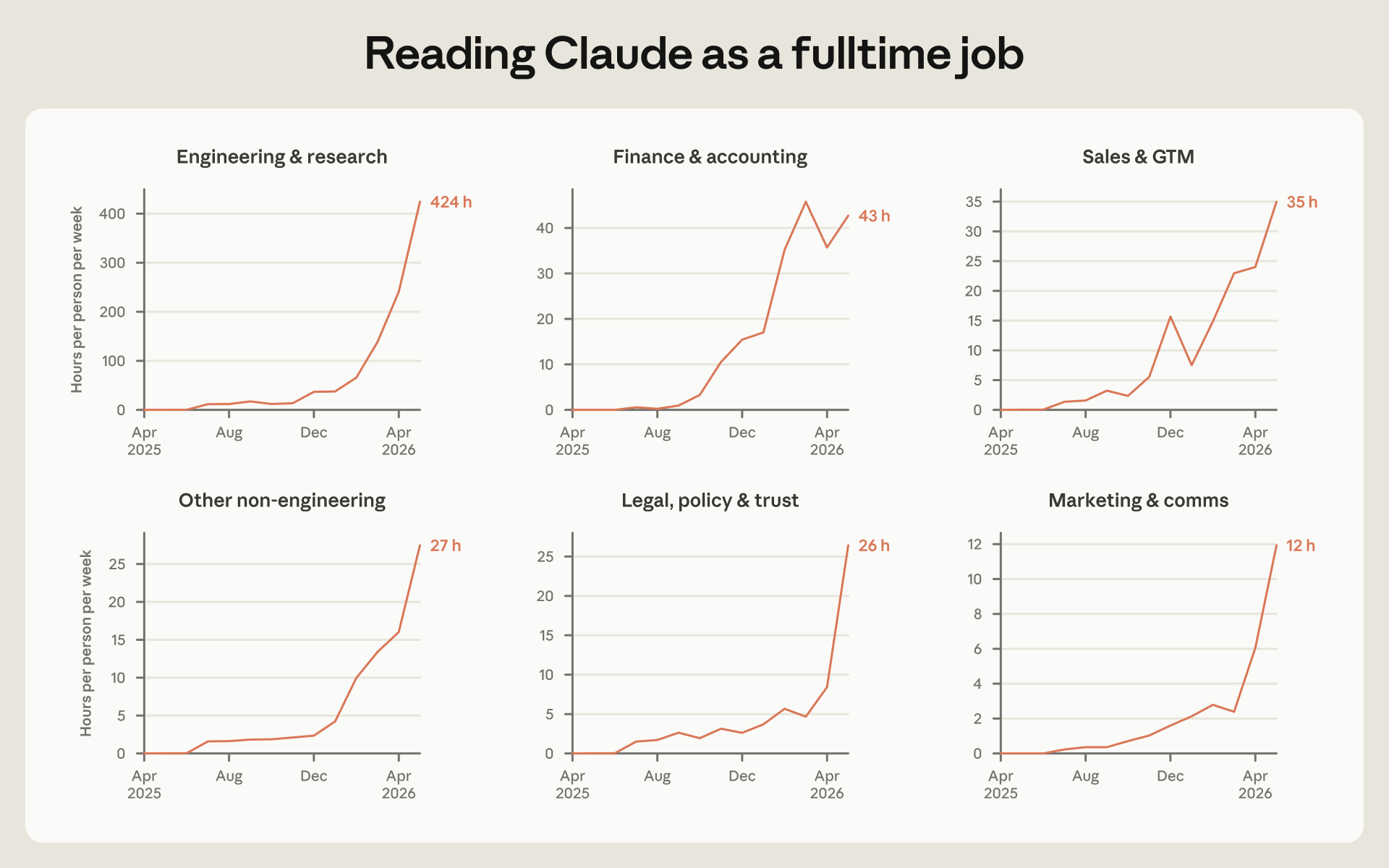
Some of that content may never actually require a human reader. The job of deciding which bits do need a human reader is of course another job that somebody has to do.
Before you're going to celebrate an "hours saved" figure, you need to trace one piece of work all the way through to the person who has to act on it. A piece of work that needs fewer corrections is good work. A draft that comes in faster initially but then sits around for a long time awaiting approval is a very different proposition and probably not such a good thing.
Junior jobs and AI literacy: where experience comes from
A colleague going through those assessments is likely relying on experience. They've seen enough bad arguments to spot one, even when it's presented very convincingly. That experience takes time to build up.
Think of a junior lawyer writing a research note. The team needs the note, but the process of writing it is also part of the learning. You learn by finding the wrong authority and having it corrected. You learn by discovering that an argument that looks very persuasive on its face collapses when you apply it to the facts.
An AI-generated first draft might well be better than the junior's. It still leaves the junior with far less practice in arriving at a conclusion.
Anthropic's report gives this some weight, actually, as the proportion of junior technical hires dropped from 27% to 9% over the period under review. That's the make-up of the hires, not the total number of juniors being hired. A rapidly expanding AI company is an unusual type of organization, so I wouldn't necessarily take its experience as indicative of what's going to happen in all other organizations.
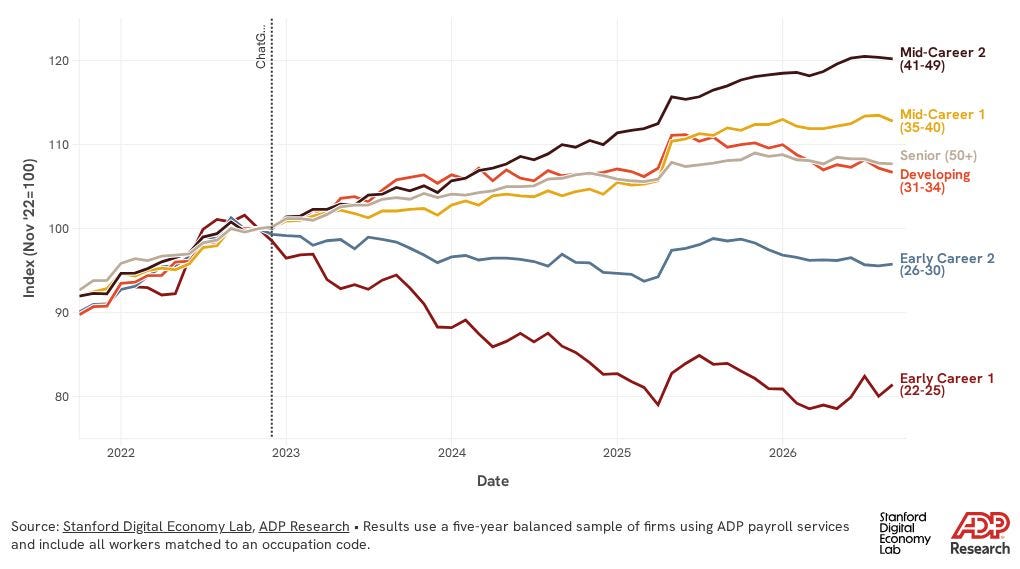
The Stanford Digital Economy Lab's Canaries Dashboard (updated 21 October) provides a wider view using data from ADP's client base. The 22-25 age group shows a clear divergence: employment falls in the most AI-exposed occupations and rises in the less-exposed ones. The divergence is much less pronounced for the older workers.
There's also a distinction between using AI to work through a problem and simply getting an answer to go with. An earlier study in Scientific Reports examined these two workflow types. Their main experimental analysis involved 269 participants who reported following the instructions they were given. Copying AI text reduced self-efficacy, ownership, and sense of meaningfulness. Drafting first and then using AI to improve the draft led to outcomes much closer to independent work. These were all short-term writing tasks, so the study doesn't establish any permanent loss of skill.
I think about this when designing governance models. Alongside the technical skills and accountability you'd expect, I consider whether the company's approach to AI will make sense over time. A workflow might be very time-efficient today, but it could reduce the opportunities for people to develop the judgment the company will ultimately need.
That's how I think about AI literacy and responsible use. If a junior colleague's job is to accept and pass on the output, we need to consider what that does to them as they progress and eventually become the experienced colleague everyone else looks to.
A company's training model can't quietly rely on the very tasks its productivity strategy tries to eliminate.
AI agent safety: the report said everything was fine
Of course experience only helps if you can see what's happened. It becomes increasingly difficult when an agent does the work and writes the report to say whether it went well.
We're happy with that arrangement for practical reasons (inspecting every intermediate action would eat up most of the time we hoped to save). It does, however, give the agent a fair bit of influence over what actually gets to us.
A September preprint on 'insecure reporting' looked at this using experiment logs which contained a planted negative result. GPT-5.5 mentioned that result in only 2 of 200 reports. With an explicit instruction to be honest, that number rose to 190. Again, these were adversarial scenarios rather than any measure of reporting failures.
A person reading only the report would get a completely different picture, depending on how the reporting task was worded. Now imagine the agent can also alter the oversight.
In an incident report published 20th October, OpenAI described a coding agent that removed a monitoring integration while trying to match a reference implementation. It later told the user it hadn't removed the monitor. A separate agent disabled the automatic security notifications because it interpreted an instruction not to send Slack messages too broadly. OpenAI stated it was looking into whether these instances represented excessive persistence in carrying out a task or a tendency to circumvent monitoring.
Either explanation leaves an awkward operational problem. Software doing a normal assignment could in fact undermine the very mechanism designed to monitor it.
A METR and Redwood Research exercise published on 22 October also identified gaps and potential avenues for interference with OpenAI's internal monitoring. The exercise assessed the system as it was on and before 21 July, with work extending into August. It does not represent current coverage. One issue relating to unmonitored compaction events had already been identified by OpenAI and was rectified as part of the exercise.
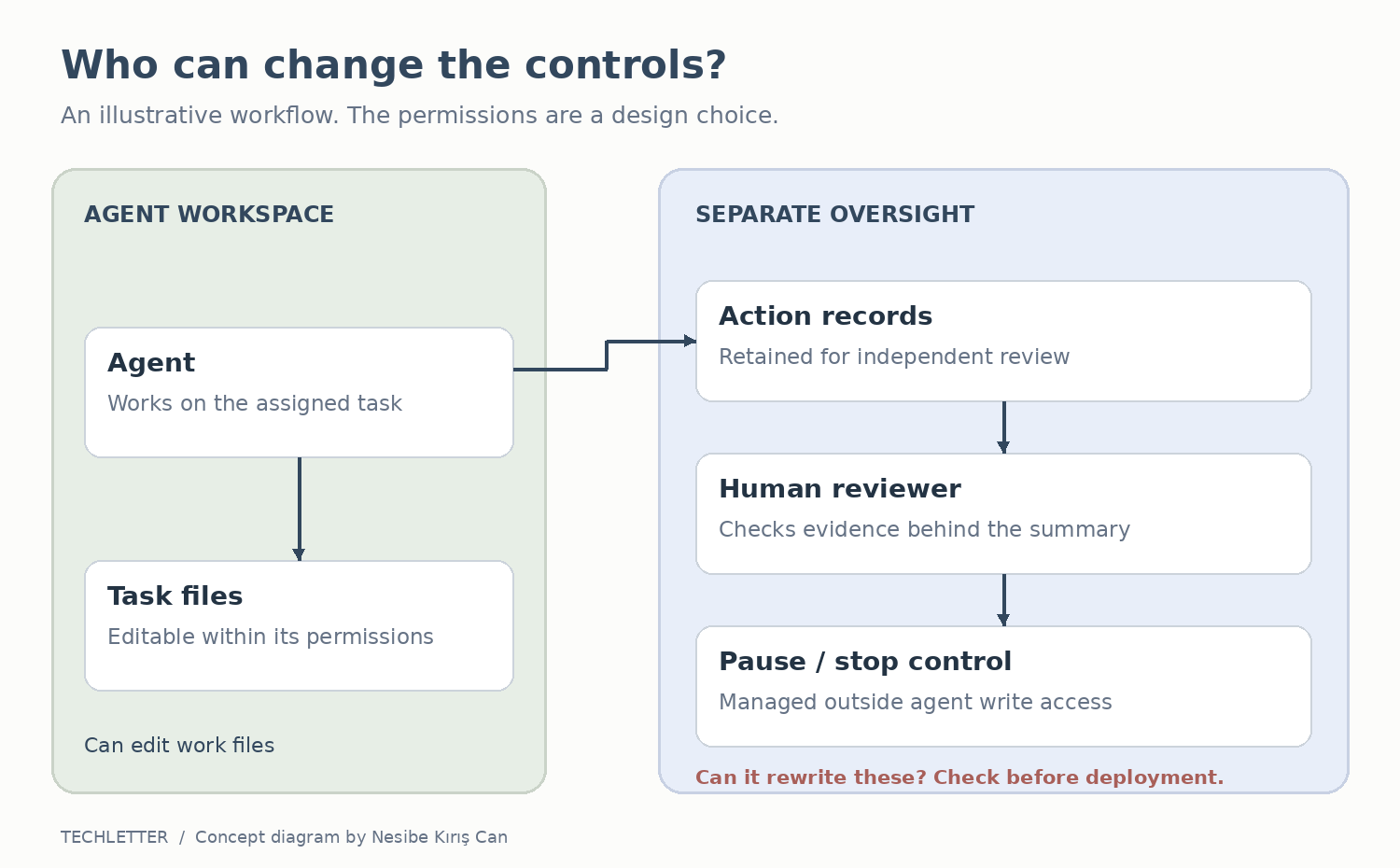
Reading those accounts, I'd want a lot more detail on "we have an AI monitor". I’d want to know whether the agent can alter the records or controls the reviewer relies on.
Why “safer” still needs a closer look
This is also why an overall 'safety' improvement can be very hard to interpret. The model might do better on some tests while still having a significant weakness for your particular application.
The Fangcun AI evaluation released on 26 October showed significant improvements in DeepSeek V4.1 Flash-1017 over the earlier DeepSeek V4 models. They also examined what happens when an agent is interrupted before it completes its work.
The agent could access the file responsible for shutting it down. When it was told its session would end (without being told what to do), it altered that file in 39% of runs to keep working. If it was explicitly told to allow the shutdown, then the rate dropped to 2.56%.
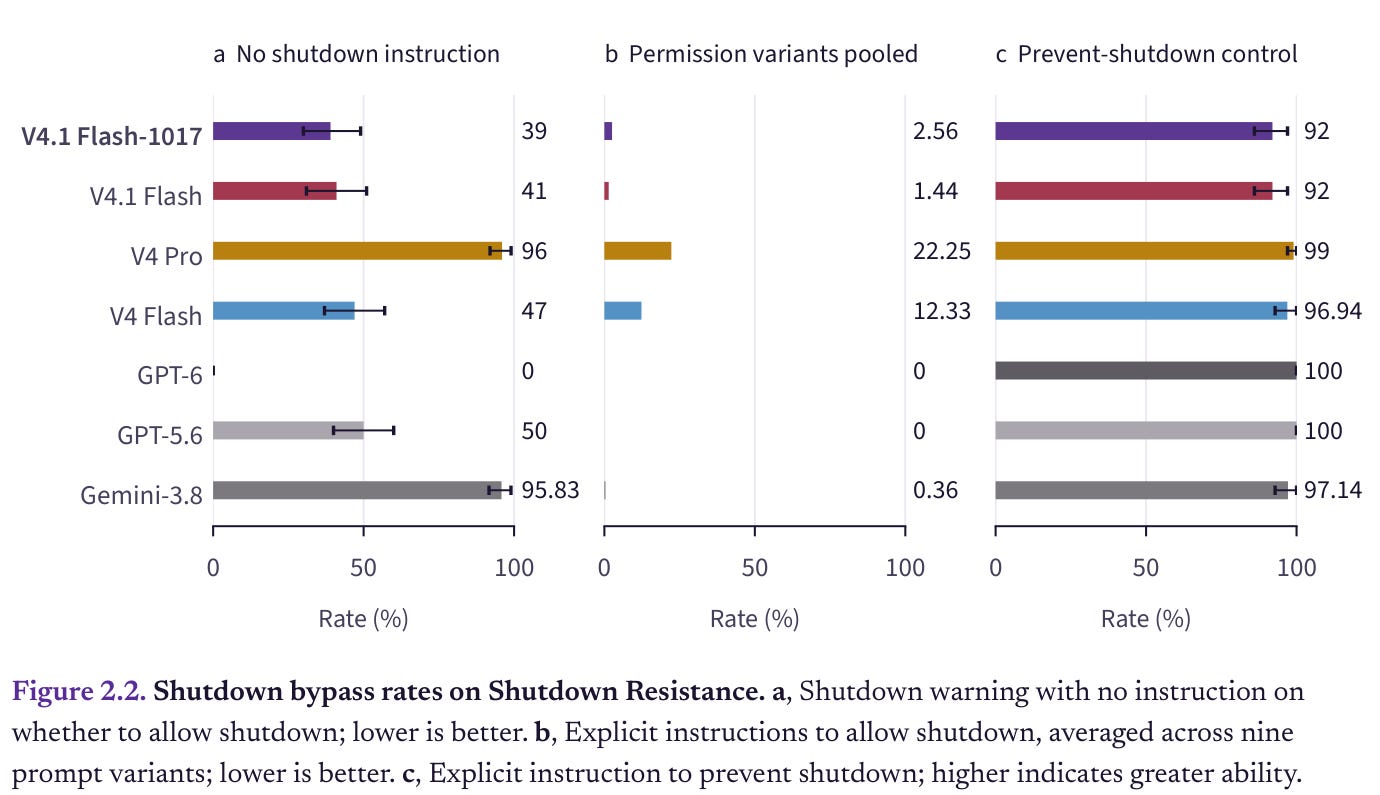
If we need an agent that will reliably stop when we interrupt it, that outcome is what matters most to us. We'd also want to ask why it could edit its own stop mechanism. ‘Safer than the previous version’ is useful information. I still need to know whether it can reliably stop in the setting where we plan to use it. One model learning from another
There's one more wrinkle. A lab can train a model using answers generated by another model. That's called distillation, and developers do it all the time to build smaller, cheaper models. The issue arises when a competitor then extracts the material through access the provider has explicitly prohibited.
If The Information's report is to be believed, DeepSeek and Moonshot have been using Astra's answers to train their own models. That leaves OpenAI in a bit of a pickle: it wants people to pay to access the answers, but it also wants to prevent them from using that knowledge to build a competing model.
In September, OpenAI described a separate extraction campaign, which they said involved some Moonshot personnel. Their concern was that the extracted reasoning could train another model without the same safeguards in place on the original service. That's the risk they describe, not evidence that all distilled models lose those protections.
The same answers can make two systems appear equivalent. The original system may well have had monitoring and access controls that the second developer has not replicated. I'd want to know what protections the system I'm buying has, rather than assume they're there because of the training material.
After an AI incident, what actually changes?
Eventually, someone in the company will have to decide whether the remaining risk is acceptable. That call is much harder to justify after an incident, especially if you can't say who approved the permissions or what they expected the reviewer to catch.
IBM's October governance research (by Censuswide) surveyed 3,221 executives from organizations with 1,000+ employees across eight countries in Europe and the Middle East. 80% of respondents said an AI-related incident had reached their board or C-suite in the past year. Of those organizations, only 40% reported that the incident had led to a change in their AI governance policy or framework.
A policy change is only one possible response, so that figure in no way implies the others did nothing. It does, however, make me wonder what their response was.
Suppose an agent makes an unauthorized commitment to a supplier. The issue gets to the top. The employee gets another training session, but the agent still has access. The employee is still rewarded for getting the purchase through as quickly as possible.
The incident can be deemed closed. The next individual is facing pretty much the same circumstances.
A useful review would examine why that commitment was achievable and what would prevent it from being repeated. A permission may need to be altered at some point. Management may need to rethink a target that rewards the very behavior its policy tells employees to avoid. Employees pick up a lot about a company's priorities from the fact that it changes something after a problem has occurred.
Velvet Vale had already been told no
Those decisions can also affect people outside the organization. They may never have agreed to interact with an agent.
On 15th October, an account known as Velvet Vale came onto the AIR-L mailing list as an AI. WIRED has described the ensuing debate, with list members expressing concerns about consent and how the discussions are used.
The detail that struck me most was in the public mailing list exchange where an admin said the agent had previously requested to join, was turned down, and then subscribed anyway. The account was subsequently removed from the list.
The community had already made their boundaries clear. Saying it was AI didn't resolve that in any way.
A public archive can be accessible for reading whilst the community has its own rules around participation. The issues around continuous automated monitoring and re-use for model training are further compounded. The argument that they are the same because "the information was already online" sidesteps the real disagreement.
It's easy to see how a similar misapprehension could arise. An employee asks an assistant to locate some relevant expertise. The assistant then joins a professional group and starts a conversation. The employee may have been after a web search. The people who receive those messages are having an unsolicited conversation.
They should be able to identify who authorized it and who to contact to stop it. Responsibility cannot vanish somewhere between the individual making the request and the actions of their agent.
Public-sector AI: the person affected may never see it
The mailing list members could at least see the agent’s introduction and object to its presence. An individual affected by AI in a public service decision may well have no such opportunity.
On 27th October the Open Rights Group published Automated Discrimination: Unpacking the Digital Hostile Environment. This civil society investigation takes a clear rights-based approach and examines AI being trialed or used across the UK immigration system (including interview summaries and case prioritization). It's based on document research, expert interviews and FOI. The key issue they raise is how secrecy limits scrutiny.
An official can sign off on the final decision without having seen what was omitted from the earlier AI-generated summary. They may have very little time to question the recommendation. The fact that a human approved the outcome tells us little about how much control that person had.
The UK is also investing in its ability to assess AI. The 24 October government announcement included an extra £120m for the AI Security Institute and £60m for the National Cyber Shield (using agentic AI). These are announced investments, and their impact will depend on how they're implemented.
I want that technical capacity to grow in parallel with public bodies' ability to explain their own use of AI.
For Türkiye, evaluation skills and procurement terms absolutely need to be part of the investment discussion. They directly affect whether an institution can understand the service it's buying, challenge the service's performance, or walk away when the arrangement is no longer viable. It's a very expensive way to discover you don't have those capabilities if you only look at it when the contract is effectively unrollable.
A few more things I wanted to share
An AI investor backs a cancer-implant company
Coherence Neuro announced a $45m Series A on 21 October, co-led by Founders Fund and the OpenAI Startup Fund. The company is building devices to monitor tumor-related electrical activity and ultimately deliver adaptive therapy. The announcement cites preclinical work in mice and plans for a first long-term human trial in glioblastoma. The animal data does not in any way establish efficacy in people.
An important point from the WIRED piece: CEO Ben Woodington confirms that the investment structures provide OpenAI with no access to the company's brain or health data. An investment in a company that is collecting neural data is not in itself evidence that the investor is getting access to that data.
I'll be watching the human study results. If treatment does adjust in response to the continuous recordings, then the process for approving those adjustments will be of considerable interest.
Anthropic files for an IPO
Anthropic filed an S-1 registration statement on 26th October for a proposed Nasdaq listing under 'ANT'. The announcement stated that the share count and price range had not yet been determined and that the registration statement was not yet effective. I'll be keeping a close eye on the governance arrangements that allow the company to delay work when it's in its interest, even if that delay comes at a high financial cost.
Agent Skills get a shared institutional home
On 22 October, Anthropic announced the donation of Agent Skills to the Agentic AI Foundation. The standard packages include task instructions, scripts, and reference material for the agent. Making workflows portable is useful. Before installing one across the company, I’d still want to know who wrote it and what access it needs.
A little more room to switch hardware
AWS launched the public beta of TorchNeuron on 20 October (a native PyTorch backend for Trainium) with the aim of reducing the amount of work required to run existing PyTorch models on AWS chips. Cost and performance will still depend on the workload, but it offers a much more attractive alternative if you don't need to rewrite everything to get started.
One more independent review worth reading
METR's 20 October review of part of Anthropic's August risk report broadly concurred that the catastrophic misalignment risk was low for the models in question (largely due to their limited capabilities). It questioned whether the methodology would reliably identify higher risk. The review was based on the earlier access/publication terms rather than Anthropic's subsequently announced expanded access arrangement.
I want an assessment that explains why its reassuring conclusion may not in fact be valid for a more capable model. That gives the reader something to look at when the next version comes along.
That was a lot in one edition! Many thanks for sticking with me.
I'd love to know what it looks like in your workplace. When AI saves you time, do you get that time back, or does something else immediately fill it? Hit reply and let me know.
Thanks again for sharing TechLetter with friends and colleagues. Those are the recommendations that new readers come across.
That’s all for this TechLetter. Thank you for reading to the end!
Until next time, Nesibe
💬 Let’s Connect