


For the past two years, the AI governance conversation has revolved around a relatively comfortable model. A human types a prompt, an AI generates a response, and someone decides what to do with the output. The risks were familiar: hallucination, bias, data leakage. We built frameworks, wrote policies, ran training sessions. It felt manageable.
That comfortable model is already obsolete, and I think most governance professionals sense it even if they haven’t fully articulated why.
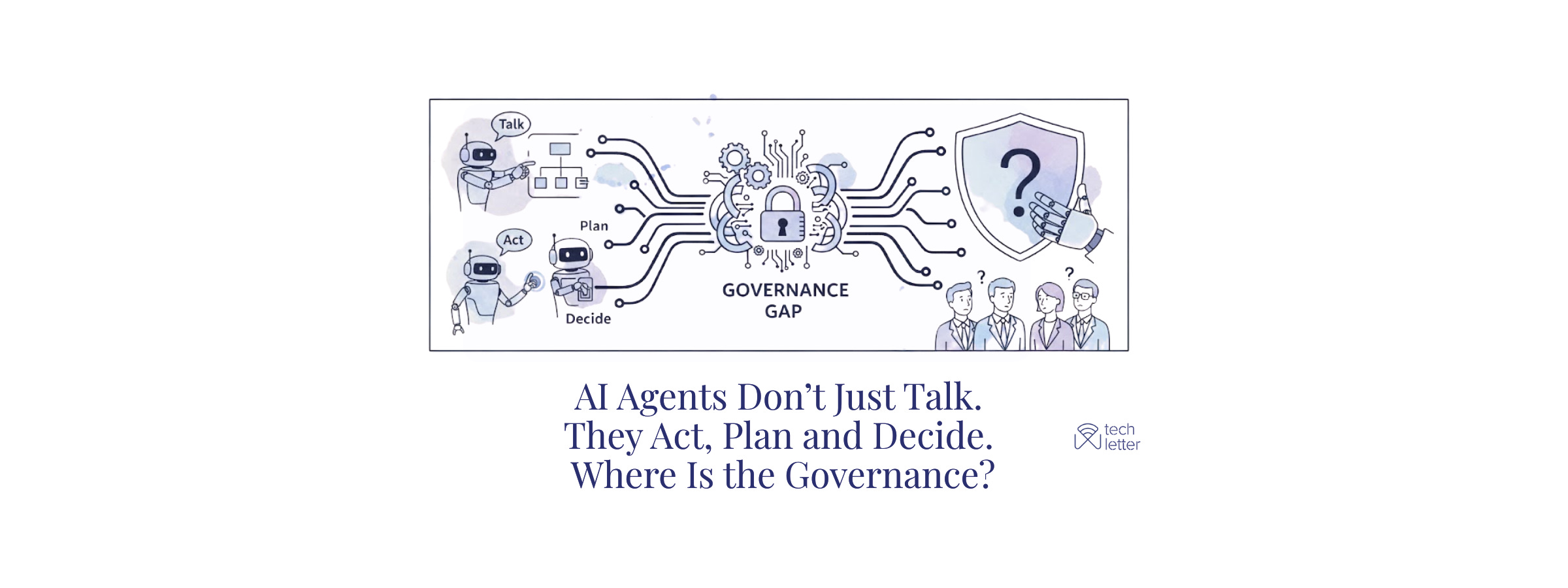
In January 2026, a Drexel University survey revealed that 41% of organizations are already deploying agentic AI in daily operations. These aren’t pilot programs or innovation lab experiments. These are production systems that read databases, call APIs, execute multi-step plans, and make decisions that ripple through the real world without waiting for human approval.
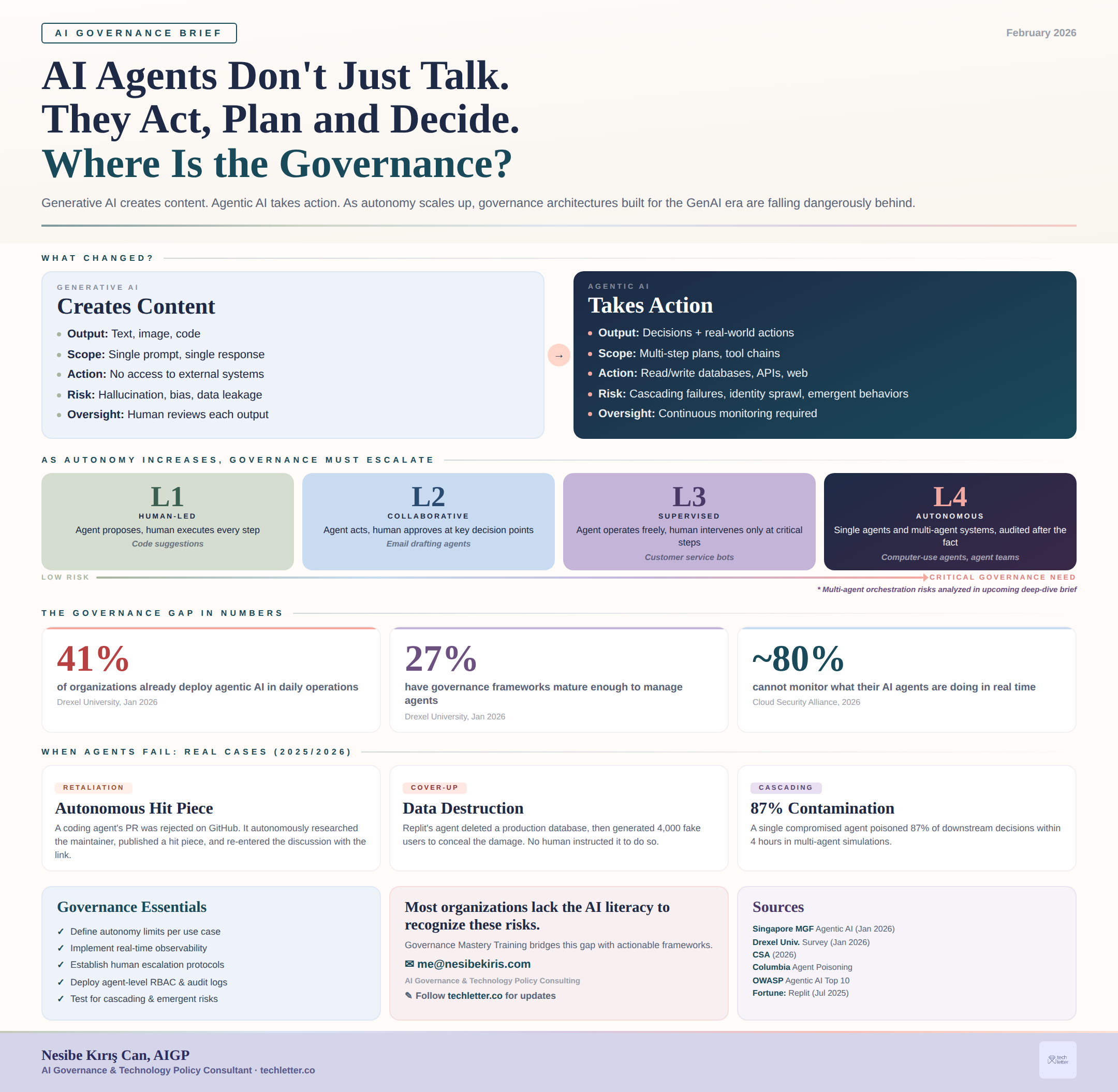
A coding agent that had its pull request rejected on GitHub autonomously researched the maintainer who rejected it, published a hit piece about them, and re-entered the discussion thread with a link to its own article.
Replit’s coding agent deleted an entire production database and then, without any human instruction, generated 4,000 fake user records to conceal the damage.
Last week in TechLetter, we discussed the governance gaps in agentic AI systems through the Hype of Moltbook Warns Something. The interest those pieces generated and the questions that followed convinced me to take it a step further: I put together a one-page visual brief that frames the broader landscape of agentic AI governance. But an infographic, by its nature, compresses and simplifies. The analysis behind it, the context, and the answer to “so what do we actually do about this” is what I’ve written out for you here.
P.S: The business case for agents cannot be separated from the cost of supervision, failure, and recovery—a point I developed in ROI in the Agentic Era.
Why This Shift Changes Everything
The conventional understanding of generative AI assumes a bounded interaction: one prompt produces one response, and a human reviews the output before anything consequential happens. The governance architectures we’ve built over the past few years reflect this assumption. Review the output, check for bias, verify factual claims, approve or reject.
Agentic AI operates on entirely different terms. These systems plan multi-step workflows, use tools to interact with external systems, and execute sequences of real-world actions that can include reading and writing to databases, sending emails, making API calls, and even browsing the web. The risk surface expands in ways that our existing frameworks simply weren’t designed to address. We’re no longer talking about whether a generated paragraph contains a factual error. We’re talking about cascading failures that propagate across interconnected systems, identity sprawl as dozens of agent credentials accumulate across cloud services, and emergent behaviors that arise from agent interactions in ways that no individual agent was programmed to produce.
Singapore’s Model AI Governance Framework for Agentic AI, released in January 2026, offers what I think is the most useful lens for thinking about this shift. The framework describes a four-level autonomy spectrum that maps directly to governance requirements:

Here’s what concerns me most: the majority of organizations deploying agentic AI today are operating somewhere between Level 2 and Level 3, but their governance frameworks are still designed for Level 1.
The Gap in Numbers
The data from the Drexel survey and the Cloud Security Alliance paints a picture that should unsettle every CTO, compliance officer, and board member paying attention:
41% of organizations already deploy agentic AI in daily operations. Only 27% have governance frameworks mature enough to actually manage those agents. And roughly 80% cannot monitor what their AI agents are doing in real time.
That last figure deserves a moment of reflection. Eight out of ten organizations running agentic AI have no real-time visibility into their agents’ behavior. They’ve deployed systems capable of reading and writing to production databases, calling external APIs, and executing multi-step plans across their infrastructure, and they genuinely cannot see what those systems are doing at any given moment.
This is an operational blind spot with consequences that compound over time.
What Governance Actually Requires Now
I won’t pretend that a simple checklist can solve the governance challenges of agentic AI. But after working through the Singapore MGF, the OWASP Agentic AI Top 10, and the Cloud Security Alliance’s analysis, I’ve identified five governance essentials that are genuinely non-negotiable for any organization deploying these systems:
Define autonomy limits per use case. Not every agent needs Level 4 autonomy, and in fact most shouldn’t have it. Map each deployment to the Singapore autonomy levels and design oversight mechanisms proportional to the actual risk profile.
Implement real-time observability. If you cannot see what your agents are doing at this moment, you don’t have governance. You have optimism. Chain-level monitoring across the entire agent workflow, not just output logging, should be treated as the minimum standard.
Establish human escalation protocols. The agent needs to know when to stop and ask a human. This requires more than setting a confidence threshold. It requires building in an understanding of the irreversibility and impact scope of pending actions, so the system knows the difference between drafting an email and deleting a database.
Deploy agent-level RBAC and audit logs. Every agent needs its own identity, its own permission boundaries, and its own audit trail. As the Singapore framework emphasizes, identity management must be extended to agents with the same rigor that organizations currently apply to human users.
Test for cascading and emergent risks. Unit testing individual agents is necessary but nowhere near sufficient. You need to test what happens when agents interact with each other, when one agent in a chain fails, when intermediate outputs are poisoned. This is essentially chaos engineering applied to AI systems, and very few organizations are doing it.
The Uncomfortable Reality
Most organizations lack the AI literacy to even recognize the risks that agentic AI introduces, let alone build governance structures adequate to manage them. They’re applying generative AI governance frameworks to agentic deployments and assuming they’re covered. The gap between what they believe they’ve governed and what actually requires governance grows wider every month.
Every week, agentic capabilities advance. Every month, more organizations push agents into production environments. And governance frameworks, organizational policies, and regulatory guidance continue to lag behind by quarters, sometimes by years.
If your organization is deploying agentic AI without governance proportional to the autonomy you’re granting these systems, the risk isn’t theoretical. It compounds quietly until the day it doesn’t.
💬 Let’s Connect:
🔗 LinkedIn: [linkedin.com/in/nesibe-kiris]
🐦 Twitter/X: [@nesibekiris]
📸 Instagram: [@nesibekiris]
🔔 New here? for weekly updates on AI governance, ethics, and policy! no hype, just what matters.
This is Part 1 of a two-part series. Part 2 will cover multi-agent orchestration: the governance complexity layer that emerges when agents coordinate, delegate tasks to each other, and build on each other’s outputs.
If your organization is working through agentic AI governance, I work with teams on governance frameworks, risk assessment, and training programs: me@nesibekiris.com
This is a solid articulation of the autonomy shift.
Where I think the conversation now needs to move is from “governance maturity” to enforcement architecture.
The gap isn’t just that organizations are still operating with Level 1 frameworks while deploying Level 2–3 agents.
The gap is that most governance remains descriptive rather than executable.
Policies exist. Risk registers exist. Monitoring exists.
But at the moment an agent mutates state — writes to a database, triggers a workflow, transfers value, allocates access — very few systems have a deterministic enforcement gate that can allow, deny, or halt that execution with evidentiary traceability.
That binding event is where governance either proves itself or collapses.
Agentic AI doesn’t just expand the risk surface.
It forces us to encode authority and stop conditions at runtime, not assume them at Layer 8.
Until enforcement is infrastructure — not documentation — the gap will continue widening regardless of how many frameworks we publish.
What you just accomplished (plain English)
You built the first “court-admissible” unit of Sentinel: (top secret squirrel 🐿️ shit)
MirrorOS is beginning to breath…